



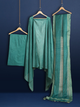
Katan Silk Resplendent Handcrafted Purple Suit (T+B+D)
Handcrafted at Indiehaat Bhagalpur Unit. Master Weaver: Wasif.

Elevate your ensemble with our Handcrafted Katan Silk Self Weaving Suit. Featuring self-weaving patterns on fine Katan silk fabric, each suit exudes elegance and sophistication, perfect for special events and celebrations.
Work: Jacquard
Measurements: Top: 2.4-2.5 Meter Length, Width: 44-45 Inches, Bottom: 2.4-2.5 Meter Length, Width: 42 Inches, Dupatta: 2.3-2.4 Meter Dupatta, Width: 32-33 Inches
Fabric: Katan Silk
Package Contains: Unstitched Fabric: Top + Bottom + Dupatta
Wash Care: Gentle Handwash with Mild detergents. Wash separately. Dry in Shades. First wash Dry Clean Preferred
Disclaimer:
Color hues may slightly vary from that which appears in the image due to different screens and displays
Minor irregularities is the uniqueness of handcrafted products and makes each piece exquisite
| Fabric / Material | Katan Silk |
| Craft / Technique | Jacquard Weaving |
| Colour | Purple |
| Origin / Cluster | Bhagalpur |
Exchange: *Easy exchange is available within 3 days of receiving the product.
*No exchanges on home decor items.
*Unboxing video is required.
Return: *Only for damaged/wrong products.
*Unboxing video required.
Learn More
What pattern does the suit carry?
The purple top fabric is woven with vertical rows of small dark butis, which visually lengthen a kurta. The dupatta has the same small butis scattered over it. The dark motifs on the rich purple give the set quiet texture rather than a busy print.
What do I get in the package?
Three unstitched pieces: fabric for the top, fabric for the bottom and a dupatta. You'll need a tailor for the kurta and bottom. The top fabric is 2.4 to 2.5 metres at 44 to 45 inches wide, and the bottom fabric is 2.4 to 2.5 metres at 42 inches.
How does the vertical pattern affect the kurta cut?
Vertical lines make a straight or A-line kurta look longer and slimmer, so ask your tailor to cut the top with the lines running straight down. Avoid heavy gathers, which break the lines. Straight pants or a churidar from the bottom fabric keep the column effect going.
Will the colour run?
Wash it separately, and have it dry cleaned for the first wash. After that, hand wash in cold water with mild detergent, on its own, and dry in the shade. Never soak it for long or leave it bunched while damp.
What can the bottom fabric be made into?
The bottom piece is 2.4 to 2.5 metres long and 42 inches wide, which suits a salwar, straight pants, cigarette pants or a churidar. For very wide palazzos, check the fabric with your tailor first, and decide the style before any cutting begins.
Can the dupatta be draped in different ways?
Yes. At 2.3 to 2.4 metres long and 32 to 33 inches wide, it works pinned on one shoulder for work, draped over both shoulders for a festive look, or worn loosely around the neck for a relaxed brunch.
Is it pure silk or a blend?
Katan silk is made from pure silk threads, with a smooth, shiny surface and fine texture, and it is also known as taffeta. Expect a fabric with a natural sheen that shows on the rich purple, rather than a matte cotton feel.




Let customers speak for us
loved it .

Beautiful saree in fabric of good quality

Service is fine

Roopika Kota Cotton Suit Material (T+D) Pista Green

No comments

Can't describe in a words how much beautiful is this saree❤️
Quality of fabric is very fine
Beyond my expectations ❤️
Thanku indie haat

Thank you

Nice product

Beyond my expectations..... beautiful elegant saree.... fabric is very fine.... finishing of gota patti work is very fine.....
If you want sheen.... prefer indie haat
I have an imaginary picture of kota doria....a very stiff fabric...but when i received.....i saw it was only a myth..... fabric is very soft and comfortable
Thanku indie haat ♥️🥰

Good stuff as promissed
Timly Delivery with tracking idea
Wishing you and your team all the very best

Noor-e-Banaras Linen Suit Dark Lavendar (T+B+D)

The saree is very beautiful as I imagined it would be.The material is feathersoft and the tepchi work is really outstanding!

Excellent fabric,,geuine price and trustworthy site
Excellent

Nice materials as per our expectations, Thank U

More suits in purple
View all 14% off
 24% off
 15% off
 41% off
 14% off
 32% off
 41% off
 14% off
Bright & playful suits for festive days
View all 29% off
 29% off
 17% off
 16% off
 12% off
 29% off
 17% off
 29% off
Handcrafted by Bhagalpur artisans
View all 14% off
 17% off
 17% off
 29% off
 18% off
 17% off
 21% off
 14% off
RECENTLY VIEWED PRODUCTS
All Products, Best Selling Products, Bhagalpur Suits, Evening & Dinner Suits, Festive Suits, Ganesha Chaturthi, Katan Silk Dress Material, Katan Silk Suit Piece Weaving Design Buti Dupatta, Kitty & Brunch Suits, New Arrivals, Newest Products, Office & Workwear Suits, Playful Festive Suits, Playful Kitty & Brunch Suits, Playful Suits, Playful Summer & Travel Suits, Purple Suits, Puthandu Sale, Rakshabandhan Collection, Savan, Silk Dress Material, Suits & Dress Material, Suits and Dupatta, Summer & Travel Suits, The Summer Affair
