

Mustard Yellow Pure Handloom Maheshwari Silk Saree, Black Flower Buti Pallu | Sangam
Mustard and black — warm ground, absolute contrast
Woven by master weaver Aafreen's household in Mominpura, Maheshwar

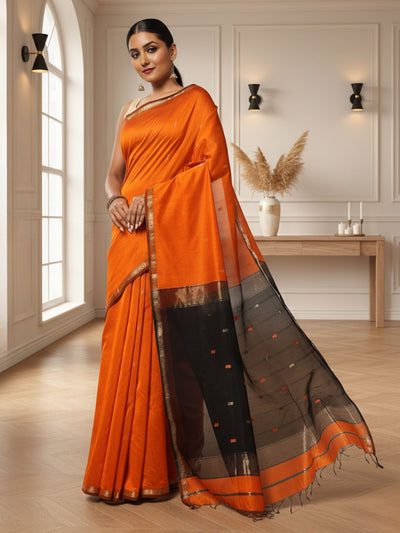
A mustard yellow body with a deep black pallu and gold worked at the division.
Why this piece
Mustard and black — warm ground, absolute contrast, nothing in between — the most-worn version of this design for a reason.
Minimal buti — the figures are kept small and sparse on the body so the colour block does the work, gathering only through the pallu.
Featherlight — 350 to 360 g at 44 to 46 GSM, weighed in our own workroom rather than guessed at from the look of the cloth.
The colourway
Mustard yellow against black is the pairing people come back for: warm enough to wear in daylight, sharp enough for an evening, and forgiving to accessorise because black takes whatever you set against it. The gold sits at the division and nowhere else it needs to.
How it is woven
It was woven in Maheshwar, in Khargone district, Madhya Pradesh. A pit loom in Maheshwar, the weft going in by hand, and a dobby carrying the buti and the border. Nothing here is machine-woven. If you have been sent a powerloom piece before, this is the difference you can feel in the hand of the cloth.
Where the weave runs a little uneven, that is the hand at the loom rather than a defect. Every piece still goes through a pre-dispatch check before it is packed.
The border, and how it wears
This is a bugdi border, which means the woven border design reads the same on both faces — something you can check with your own hands when the piece arrives.
Weighed and published rather than described: 350 to 360 g at 44 to 46 GSM. The drape is soft from the first day and stays soft after cleaning, the pleats sit where you set them, and the semi-sheer body takes a petticoat underneath.
Specification
Total length: 6.3–6.5 m, including an 80–90 cm blouse piece
Width: 45–46 inches
Weight: 350–360 g, measured in-house
Fabric weight: 44–46 GSM
Body: semi-sheer; wear it with a petticoat
Drape: soft, holds its pleats, and stays soft after the first clean
Loom: pit loom, with the weft inserted by hand
Patterning: dobby-set, on body, border and pallu
Finishing: pallu kuchu, selvedge and edges finished; fall and pico on request
Woven in: Maheshwar, Khargone district, Madhya Pradesh
Country of origin: India
Net quantity: one saree with attached blouse piece
Care: Dry Clean Only
Care and storage
- Professional dry clean only. Home washing is not recommended.
- Air-dry in the shade, without wringing.
- Iron inside out on a low-to-medium setting, under a cotton press cloth.
- Store it wrapped in breathable cotton or muslin, in a cool dark cupboard.
- Refold along fresh lines every three to six months.
Dispatch
This piece is held in stock rather than made to order, so hand weaving does not put you in a queue. About half of all orders leave the next day, most go within two to three days, and most orders inside India arrive in three to seven days.
A note on colour
This piece is mustard yellow through the body, with a black pallu. Screens, camera settings and the light a photograph was taken in all move a shade a little, so the piece that reaches you may sit slightly away from the image on this page. Every colour in this range has been tested for fastness on wash and rub.
Product details
Country of origin: India. Net quantity: one saree with attached blouse piece. Care: Dry Clean Only.
Exchange: *Easy exchange is available within 3 days of receiving the product.
*No exchanges on home decor items.
*Unboxing video is required.
Return: *Only for damaged/wrong products.
*Unboxing video required.
Learn More
What exactly do I receive?
One unstitched Maheshwari silk saree, 6.3 to 6.5 m long including an 80 to 90 cm blouse piece attached to the saree, and 45 to 46 inches wide. The blouse piece is unstitched fabric and its price is already in the price on this page. The measurements are uniform across this weave and are measured in-house, not taken from a supplier sheet.
Is the saree stitched, and are fall and pico done?
It is an unstitched drape — you pleat and drape it yourself, or have it pre-pleated locally if you prefer. Fall, pico and edge finishing are not done before dispatch, but we will do them on request before the piece is sent.
How do I know it is handwoven and not powerloom?
It is woven on a pit loom with the weft inserted by hand, and the patterning on body, border and pallu is dobby-set on the loom. The Handloom Mark is held on record against these pieces, they are woven by master-weaver households in Mominpura, Maheshwar, and the weaver confirms each piece. Nothing we sell is machine-woven.
What is a bugdi border?
Bugdi describes the woven border design reading the same on both faces of the cloth. It is woven into the border on the loom, and you can turn the edge over and see it for yourself.
How should I clean and store it?
Professional dry clean only; home washing is not recommended. Air-dry in the shade without wringing. Iron inside out on a low-to-medium setting under a cotton press cloth. Store it wrapped in breathable cotton or muslin in a cool, dark cupboard, and refold it along fresh lines every three to six months so no single crease is held for years.
Will the colour bleed on the first clean?
Every colour in this range has been tested for fastness on both wash and rub. That is a test result rather than a reassurance. Dry cleaning remains the instruction.
What if the shade that arrives is not the shade on my screen?
Screens and camera settings shift colour, so the mustard yellow may read a little differently in your own light. If the shade does not match, or you are not satisfied with the quality, we will exchange the piece within the stated window and condition requirements.
What is the return and exchange window?
Two days from delivery, and the piece has to be unused, with its tags and its original packaging. Within that window we exchange for a colour mismatch or for dissatisfaction with quality.
Is it see-through? What do I wear underneath?
The body is semi-sheer — that is what 44 to 46 GSM and 350 to 360 g of cloth feels like — so it is worn with a petticoat, matched to the body colour or deliberately set against it.
Which occasions does it suit?
Festival and festive wear first, then formal and ethnic occasions and the lighter events in between. As a wedding or reception guest it is comfortable for a long day.
What do the motif and border names mean?
Buta and buti are the canonical spellings for the small woven figures scattered across the cloth; the same motif circulates as butta, butti and booti, and they all mean this. The figure here is a flower buti. Zari (also written jari) is the metallic thread worked into the border and the pallu, and a double design border means two parallel border designs run down the edge rather than one. Here small sparse buti cover the mustard body and larger gold figures gather in the black pallu.
When will it be dispatched and how does delivery work?
These sarees are held in stock, not made to order. About half of all orders leave the next day, most within two to three days, and most orders inside India arrive in three to seven days. Shipping within India is free, Cash on Delivery is available, and we ship worldwide with international carriage charged on actuals.
How long will it last?
Cared for as instructed, this is a piece to keep and to pass on rather than one to wear for a single event. The drape does not stiffen or go slack after the first clean, and the tracked defect and colour-complaint rates on this weave are negligible.
The weave looks slightly uneven in places. Is that a defect?
No. A hand-inserted weft leaves small irregularities behind — the occasional slub or an uneven pick — and they are characteristic of hand weaving rather than faults. Every piece is finished at the pallu kuchu, selvedge and edges, and passes a pre-dispatch check before it is packed.
YOU MAY ALSO LIKE
Let customers speak for us
Good stuff as promissed
Timly Delivery with tracking idea
Wishing you and your team all the very best

Noor-e-Banaras Linen Suit Dark Lavendar (T+B+D)

The saree is very beautiful as I imagined it would be.The material is feathersoft and the tepchi work is really outstanding!

Excellent fabric,,geuine price and trustworthy site
Excellent

Nice materials as per our expectations, Thank U

I got my product. It is lovely and the quality is as promised. I'll continue ordering from Indiehaat. I'm from Hyderabad.

Nice collection
It’s always appreciated for handloom n hand woven fabrics of INDIA
Thanks 🙏

The print as well as the fabric was good

I loved the quality of the fabric. The colour was also perfect 👌

I am always fan of your product,.This time there is no difference as before

Roopika Kota Cotton Suit Material (T+D) Pista Green

The fabric was awesome, the print was fabulous and the colours were vibrant! Thanks for delivering the perfect product!

I bought this saree for a reunion party, and it was really beautiful.

I purchased a saree from Indiehaat, and loved it. A big fan of Linen sarees, and this one was super cool.

RECENTLY VIEWED PRODUCTS
Ada-e-Ramazan, All Products, Best Selling Products, Diwali Sale, Durga Pooja, Ganesha Chaturthi, Gudi Padwa Sale, Haldi Collection, Independence Day Sale, Maheshwari Silk Sarees, Maheshwari Silk Sarees Handloom Zari Border, Navratri, New Arrivals, Newest Products, Puthandu Sale, Rang Rasiya, Sangam, Sarees, Savan, Silk Sarees, Silk Sarees Ad, Trending, Ugadi - The New Year, VaraMahalakshmi Sale, Wedding Elegance