



Noor-e-Banaras Lichi Silk Black Suit (T+B+D) Brocade Weaving
Handcrafted in Udhna, Gujarat by master weaver Rashmi.

Elevate your ethnic charm with our Banarasi Lichi Silk Suit featuring exquisite brocade weaving. Perfect for festive occasions, this suit showcases luxurious texture, intricate craftsmanship, and timeless traditional elegance.
Work: Brocade Weaving
Weight: 500 gm
Measurements: Top: 2.5-3.0 Meter, Bottom: 2.4-2.5 Meter, Dupatta: 2.4-2.5 Meter
Fabric: Banarasi Lichi Silk
Package Contains: Unstitched Fabric: Top + Bottom + Dupatta
Wash Care: Dry Clean Preferred or Gentle Handwash with Mild detergents. Wash separately. Dry in Shades.
Disclaimer:
Color hues may slightly vary from that which appears in the image due to different screens and displays
Minor irregularities is the uniqueness of handcrafted products and makes each piece exquisite
| Fabric / Material | Banarasi Lichi Silk |
| Craft / Technique | Brocade Weaving |
| Colour | Black |
| Origin / Cluster | Gujarat |
**Brocade Weaving** is a luxurious textile technique where decorative patterns are woven into the fabric, often using gold or silver threads. Originating in India, it creates raised motifs like florals, paisleys, or geometric designs. Commonly used in Banarasi sarees, brocade weaving adds opulence, texture, and richness to traditional garments and upholstery.
Exchange: *Easy exchange is available within 3 days of receiving the product.
*No exchanges on home decor items.
*Unboxing video is required.
Return: *Only for damaged/wrong products.
*Unboxing video required.
Learn More
What colours pair best with black?
Black takes almost any accent. Gold makes it festive and rich; silver keeps it cool and modern. For colour, a fuchsia, mustard or emerald stole, potli or pair of juttis gives a lively pop. Red lipstick with small gold earrings is a simple, sharp combination. Keep accents to one or two colours so the brocade still leads.
Is it ready to wear, or will I need a tailor?
You'll need a tailor. The set is sold as unstitched fabric: a top piece, a bottom piece and a dupatta. Unstitched means you choose the fit and style, a straight kurta or something with more flare, rather than adjusting a ready-made size that may not suit you.
Will stripes and paisleys together look busy?
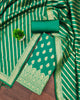
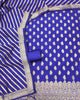
Not really, because each piece has one idea: gold leaf butis with a paisley hem band on the top fabric, and diagonal gold stripes on the dupatta. Keep jewellery and footwear simple, and drape the dupatta on one shoulder if you want the paisley hem band to stay visible.
Is the pattern woven in or printed?
Woven in. Brocade weaving builds the decorative pattern into the cloth on the loom, often with metallic threads, so the motifs are part of the fabric rather than printed on top. You can feel a slight raised texture over the pattern, and it won't wash or rub off the way a print can.
Any tips I should pass on to my tailor?
Three things help with brocade. Overlock or bind the seams, because woven patterns can fray once cut. Plan the layout so motifs sit centred on the front and upright on the sleeves. And keep the design simple, with few darts and seams, so the woven pattern isn't broken up.
Is the bottom fabric enough for palazzos?
The bottom piece is 2.4 to 2.5 metres. That usually covers straight pants or a slim palazzo for most sizes, but a very wide, flowing palazzo can need more. Straight or slightly flared bottoms also keep the look neat under a brocade kurta.



Let customers speak for us
Beautiful saree in fabric of good quality

Service is fine

Roopika Kota Cotton Suit Material (T+D) Pista Green

No comments

Can't describe in a words how much beautiful is this saree❤️
Quality of fabric is very fine
Beyond my expectations ❤️
Thanku indie haat

Thank you

Nice product

Beyond my expectations..... beautiful elegant saree.... fabric is very fine.... finishing of gota patti work is very fine.....
If you want sheen.... prefer indie haat
I have an imaginary picture of kota doria....a very stiff fabric...but when i received.....i saw it was only a myth..... fabric is very soft and comfortable
Thanku indie haat ♥️🥰

Good stuff as promissed
Timly Delivery with tracking idea
Wishing you and your team all the very best

Noor-e-Banaras Linen Suit Dark Lavendar (T+B+D)

The saree is very beautiful as I imagined it would be.The material is feathersoft and the tepchi work is really outstanding!

Excellent fabric,,geuine price and trustworthy site
Excellent

Nice materials as per our expectations, Thank U

I got my product. It is lovely and the quality is as promised. I'll continue ordering from Indiehaat. I'm from Hyderabad.

More suits in black
View all 29% off
 12% off
 21% off
 21% off
 27% off
 15% off
 15% off
 23% off
Rich & regal suits for festive days
View all 14% off
 14% off
 37% off
 7% off
 14% off
 37% off
 14% off
 37% off
Handcrafted by Gujarat artisans
View all 41% off
 41% off
 41% off
 41% off
 41% off
 41% off
 32% off
 41% off
RECENTLY VIEWED PRODUCTS
All Products, Banarasi & Brocade, Best Selling Products, Black Suits, Evening & Dinner Suits, Festive Suits, Ganesha Chaturthi, Gujarat Suits, Handwoven Crafts, Labor Day Loyalty, Lichi Silk Suit Set, New Arrivals, New Spring arrivals, Newest Products, Puthandu Sale, Rakshabandhan Collection, Regal Festive Suits, Regal Suits, Savan, Silk Dress Material, Suits & Dress Material, Suits and Dupatta, The Summer Affair, Ugadi Sale
